Learning ACT and Associated Resources
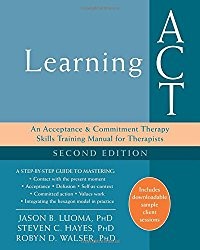
I’m co-author of Learning ACT, a comprehensive skills-training manual for helping therapists learn how to do ACT. It’s not a book that outlines all the basic tools and techniques of ACT, but instead it focuses on helping therapists apply the model with skill and flexibility. The second edition of Learning ACT was created to pull together all the developments that have occurred over the last decade since the first edition.
Associated Resources:
- Free accessories, including some videos, you can download here
- ACT Core Competency Rating Form (2nd Edition)
- Guide to Learning ACT
Learning ACT Resource Guide
 Every year, we update the Learning ACT Resource Guide, an e-book that provides a huge list of resources from around the web that will help you along your journey of learning ACT.
This free e-book contains a list of every ACT book ever written (as best as we can find). The Learning ACT Resource Guide helps you sort through all the books, podcasts, videos, online learning courses, exercises, and other resources that will help you learn & master ACT.
This guide gives you ideas on how to get started with ACT and how to advance your skill and knowledge of the therapy over time. It’ll connect you with resources, with ideas on how to practice and learn, and with strategies for skill development.

Values In Therapy: A Clinician’s Guide to Helping Clients Explore Values, Increase Psychological Flexibility, and Live a More Meaningful Life
Values in Therapy is a practical guide on how to do effective values work for any therapist. Based on tools for working with values from acceptance and commitment therapy (ACT), this practical guide is written to be accessible to any therapist of any theoretical orientation. While values work may appear deceptively simple, it’s often difficult to effectively carry out in practice. That’s where this comprehensive guide comes in. For any therapist who is looking to incorporate values-based work into your treatment, this essential guide provides everything you need to help clients connect with what really matters to them, so they can live full and meaningful lives.
Comprehensive List of Every ACT Book Ever Published
Ever year, we do our best to update this list of every book on ACT ever published, both for therapists and the public. The list is organized by topic so you can easily find what’s relevant to you.
Portland Psychotherapy Training
We host regular ACT training events through Portland Psychotherapy Training both online and offline. To learn about my upcoming training events, you can sign up for our newsletter below:
Sign up for our Newsletter
Using ACT with Self-Critical and Shame-Prone Clients
We have created hundreds of pages of resources on working with highly self-critical and shame prone clients, including therapist reference materials, audio recordings, and client handouts at http://www.actwithcompassion.com/.
ACT Audio Recordings for Therapists and Clients
- Awareness Meditation Audio Recording – Click here to download an MP3 audio recording of a 15-minute awareness exercise. The file isn’t professional quality, but it is quite understandable. Feel free to share the file with others or pass on the recording in any way. The audio recording largely parallels the awareness exercise presented in the original ACT book (Hayes, Strosahl, & Wilson, 1999). A copy of the handout from the book that goes along with the audio can be found here.
- Leaves on the stream meditation – This is a recording of a classic ACT exercise, the leaves on the stream meditation ( download mp3 here). This exercise is recorded in a woman’s voice and lasts about 13 minutes and has an extended beginning that focuses on becoming present to the moment and creating the visualization before beginning the exercise.
- ACT audio recordings through Portland Psychotherapy – You can download additional audio recordings covering a variety of ACT processes:
- I’ve pulled together a range of meditation recordings aimed at helping people who are highly self-critical and shame prone at actwithcompassion.com.
- Here you can download a series of loving-kindness meditations that are specifically tailored to people who are highly self critical and shame prone.
- Audio recordings on ACT from Russ Harris
ACT Case Conceptualization Form and Outline
- Below is a case conceptualization form that you print out and use in your practice. In my core competency training, I recommend people use this outline with at least two ACT clients when they are first learning ACT. Utilizing this form can help you learn how to better contextualize ACT to the unique aspects of a particular client’s life. The second file contains guidelines on how to fill out the form. The second form is essentially a summary of Chapter 8 of A Practical Guide to Acceptance and Commitment Therapy (2004), Eds. Steven C. Hayes & Kirk Strosahl . Please reference that chapter instead for more detailed information. If you decide to use the form and have any feedback or modify the form in any way that you think is useful, I’d love to hear about it!
- Case Conceptualization Form (by Jason Lillis & Jason Luoma)
- Case Conceptualization Outline
ACT Handouts for the Original 1999 ACT Book
- I have been using these ACT handouts for years with my clients. The handouts are in a Microsoft Word file and are essentially some of the ones that are in the original ACT book, Acceptance and Commitment Therapy: An Experiential Approach to Behavior Change (1999; paperback version 2003) . There may be a few changes here and there, but any changes are not extensive. Unfortunately, there is no easy way to reproduce the ones from the book and it took me a while to turn these into an electronic format. In addition, the original book is out of print. So I am putting these up here as a service to the ACT community for those who already have the book, but don’t have the time to turn the forms into an easily reproducible format. As far as I understand the Fair Use Doctrine, if you are going to use them, you should have the book they are adapted from.
ACT Videos
These videos are accessible to clients and illustrate some of the basic concepts of ACT:
Passengers on the Bus Metaphor
An animation about avoiding feelings
Other Resources for Therapists
The Association of Contextual Behavioral Science has an extensive list of resources for therapists trying to learn ACT and use it in their practice.
I have posted some additional resources on my website, LearningACT , that I hope will be helpful.